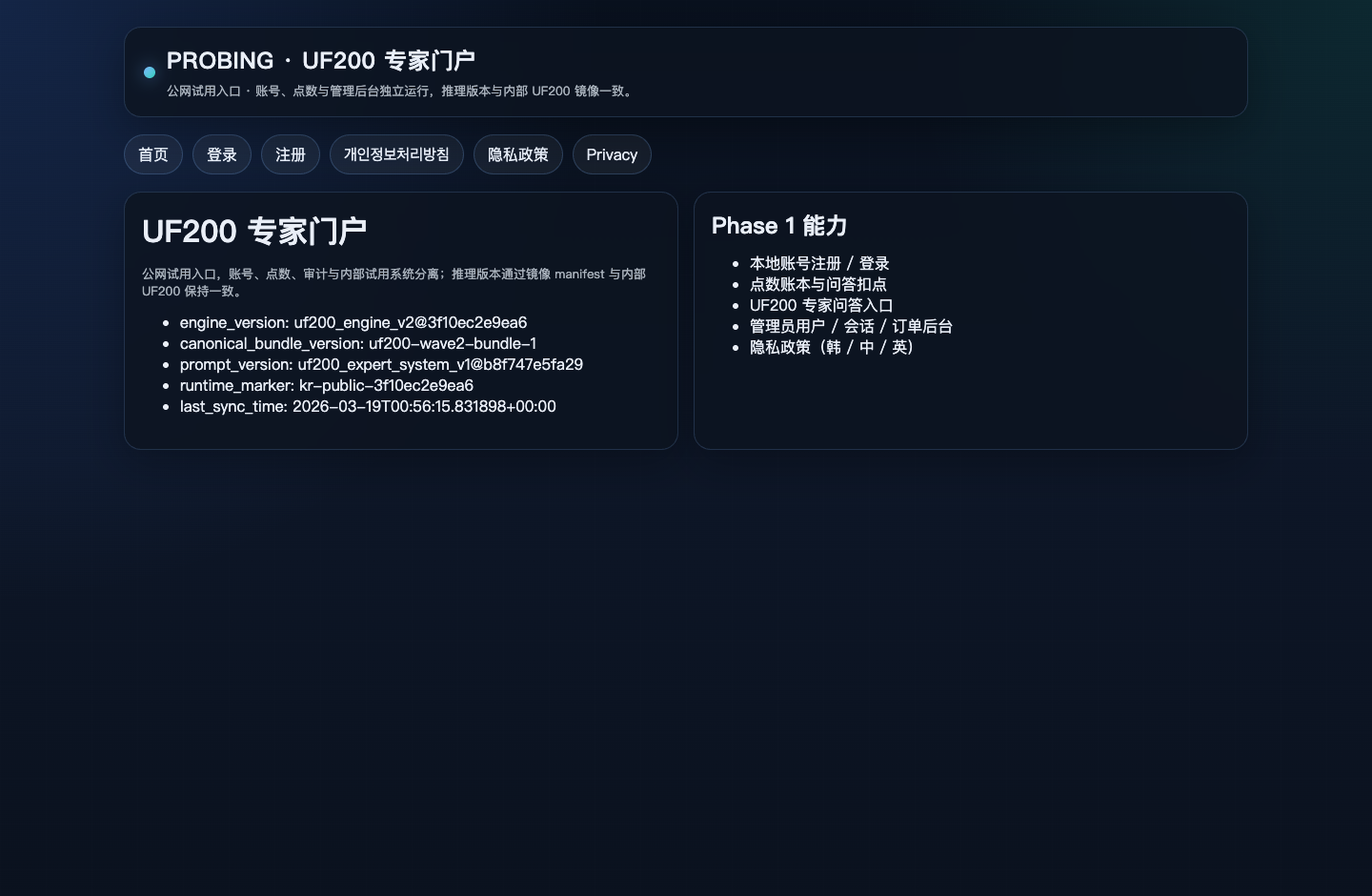
Public wedge
Public UF200 portal overview
A live external entry point already exists. The UI is still Chinese-facing today, while this homepage keeps the English proof summary and platform framing.
Built from real service workflows, manuals, logs, and field cases. Starting with UF200. Expanding across probers, ATE, and fab-side workflows.
PROBING-AI turns expert judgement chains and service knowledge into deployable expert systems. It narrows the problem first, then moves engineers to the next best inspection path.
UF200 public portal currently opens in Chinese. This page stays English-first as the proof summary.
A real external entry point exists today.
Runtime, prompts, bundles, and sync markers are versioned.
Engineers stay inside review, escalation, and final judgement loops.
Designed for enterprise-safe deployment boundaries.
Manuals, logs, and field knowledge do not live in one language.
The core value is not “give a long answer.” It is “narrow first, inspect next.” A representative UF200 flow looks like this.
The issue enters as an engineering symptom, alarm, or maintenance complaint, not as a generic chat prompt.
The system asks the shortest clarifying questions first: before pickup, after visibility, after alignment, after recovery, or after a data change.
Instead of forcing a generic failure tree, the system narrows the likely path and reduces unnecessary inspection loops.
Check current device and correction data, sensor state, visibility chain, and reference consistency before going wider.
The public UF200 wedge already shows real product shape: a visible entry point, versioned runtime surface, and operating boundaries that go beyond a chat demo.
A live external entry point already exists. The UI is still Chinese-facing today, while this homepage keeps the English proof summary and platform framing.
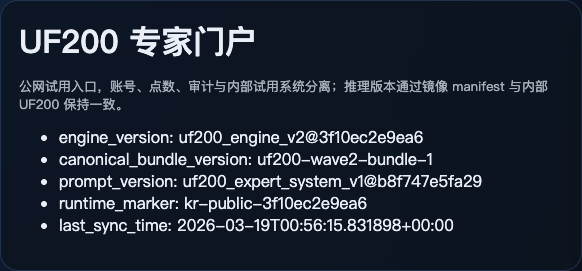
Engine version, bundle version, prompt version, runtime marker, and sync time are visible on the public-facing surface.
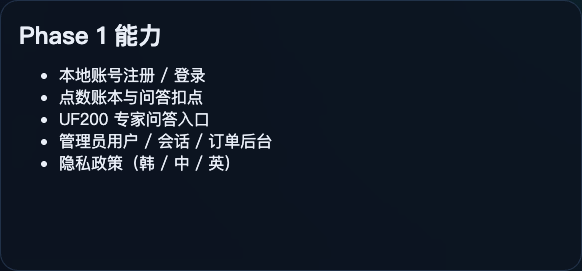
Account, points, session, order, and admin-related flows are visible as part of a bounded public system, not a free-form demo.
Semiconductor equipment engineering does not lack documents. It lacks a scalable way to turn scattered knowledge into the next correct action under time pressure.
Manuals can run thousands of pages. Logs, cases, SOPs, and service notes live in different places. Field knowledge spans multiple languages.
Strong equipment engineers take years to train. The best troubleshooting paths often live in a few heads, not in a reusable system.
Once troubleshooting loops expand, cost escalates fast from tool-level delay to line-level impact. Remote support loses time reconstructing context.
The product direction is simple: turn manuals, logs, cases, and field service knowledge into operational reasoning that moves engineers toward the next best inspection path.
Manuals, logs, cases, and multilingual service material become structured engineering knowledge.
The system narrows likely causes and decides what should be inspected next.
Human-reviewed diagnosis, escalation, and support workflows turn reasoning into operating action.
The wedge strategy matters because it explains both the entry point and the platform direction. UF200 is where the method is concrete enough to prove, and adjacent enough to generalize.
It is a high-value engineering workflow with dense knowledge, recurring field issues, and clear support pressure.
It proves that expert judgement chains can be turned into a live system with product boundaries, review loops, and operational versioning.
The same knowledge and workflow architecture can extend into more probers, 93K / ATE, and wider semiconductor equipment workflows.
The company direction is not “one equipment expert forever.” It is an equipment intelligence layer that starts with one live wedge and expands where the method still fits.
Live wedge. Real engineering conversations. Real workflow proof.
Adjacent probe and handler workflows where the same expert method applies.
Expansion from equipment-side diagnosis into tester and validation-side engineering work.
Toward a broader semiconductor equipment intelligence layer and the path to the AI OS for Fabs.
Enterprise adoption depends on boundaries, review loops, and deployment shape. The platform has to respect real equipment environments from day one.
The system comes out of actual service and support practice, not generic AI showcase work.
Final engineering judgement stays with people. The system is designed to assist, not bypass, that process.
The deployment direction supports customers that need controlled boundaries and equipment-facing ownership.
Field reality spans multiple languages across manuals, logs, service notes, and engineering context.
The public wedge demonstrates usability. The long path is enterprise-safe deployment, not public-only trial forever.
If you want to review fit for equipment engineering, remote support, training, or adjacent fab-side workflows, start with a technical conversation.
The UF200 public portal currently opens in Chinese. This homepage remains the English proof summary.